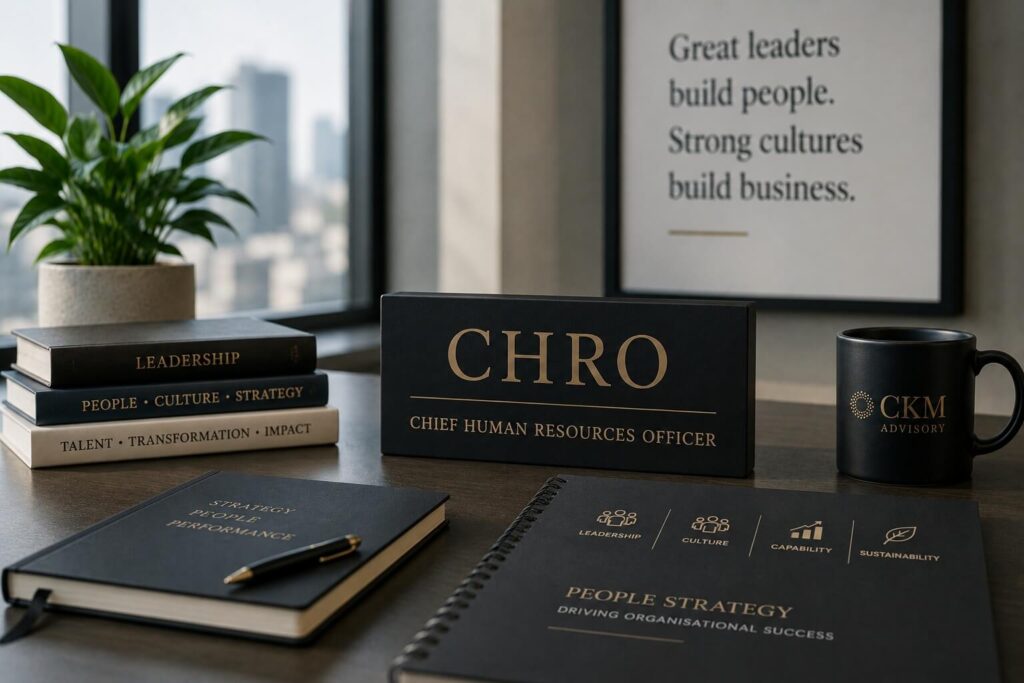
The role of the Chief Human Resources Officer has undergone significant transformation.
For many years, HR leadership was largely associated with talent management, employee relations, policy oversight, and workforce administration. While these responsibilities remain important, the demands placed on organisations and leadership have changed considerably.
Today, the CHRO increasingly occupies a far more strategic position.
In many organisations, the role has evolved from functional leadership to enterprise leadership — influencing strategy, organisational transformation, culture, leadership capability, and business sustainability.
This evolution reflects a broader reality.
People are no longer viewed simply as a resource to be managed.
They are increasingly recognised as a source of competitive advantage.
The CHRO as a Business Leader
Modern organisations operate in environments characterised by disruption, workforce shifts, digital transformation, and increasing stakeholder expectations.
These conditions create challenges that cannot be solved through operational expertise alone.
Leadership capability, organisational agility, succession readiness, culture, and workforce resilience have become central business concerns. As a result, the CHRO is increasingly expected to contribute not only people insight, but business insight.
This requires a shift in perspective.
The contemporary CHRO is not simply an adviser on workforce matters.
They are a strategic business leader.
This means engaging meaningfully in commercial discussions, understanding business priorities, and helping shape organisational decisions that influence both performance and people outcomes.
The role therefore extends well beyond traditional HR boundaries.
Strategy and Culture Are Increasingly Connected
One of the most significant shifts in the CHRO role is the growing recognition that strategy and culture are inseparable.
Organisations may define ambitious strategic objectives, yet execution ultimately depends on people and organisational behaviour.
Culture influences:
- collaboration
- accountability
- innovation
- trust
- adaptability
- leadership effectiveness
This places the CHRO at an important intersection.
Increasingly, organisations look to HR leadership to help align culture with strategy and ensure that organisational values are not merely aspirational, but lived and experienced.
This responsibility is both strategic and organisational.
Culture cannot be treated as an isolated people initiative.
It must support business direction.
Leading Through Change and Complexity
The modern CHRO also plays a defining role during periods of change.
Transformation, restructuring, mergers, technological disruption, and changing workforce expectations all place pressure on organisations and leadership teams.
Change is rarely experienced only as a structural process.
It is experienced by people.
This makes leadership through change an important capability for HR executives.
The CHRO often becomes a key adviser to executive teams, helping leaders navigate uncertainty while maintaining trust, communication, and organisational cohesion.
In this context, emotional intelligence and strategic judgement become particularly valuable.
The most effective CHROs understand both organisational systems and human experience.
Talent and Leadership Capability as Strategic Assets
Organisations increasingly recognise that sustainable success depends not only on attracting talent, but also on developing leadership capability.
This has elevated succession planning, executive development, and leadership readiness as board-level concerns.
The CHRO plays an important role in ensuring organisations remain prepared for the future.
This includes:
- Identifying leadership potential
- Developing succession pipelines
- Strengthening leadership capability
- Supporting executive effectiveness
- Building resilient talent systems
The focus is no longer simply filling roles.
It is building leadership capacity for long-term organisational success.
This represents a meaningful shift in how talent leadership is understood.
The CHRO and the Board Agenda
As governance expectations continue to evolve, people-related matters increasingly feature in board discussions.
Boards are paying closer attention to:
- organisational culture
- executive succession
- diversity and inclusion
- ethics and conduct
- workforce wellbeing
- stakeholder trust
- organisational reputation
These are not peripheral matters.
They influence risk, sustainability, and organisational legitimacy.
The CHRO therefore frequently serves as an important bridge between executive leadership and board oversight.
This requires credibility, business understanding, and the ability to translate people insight into strategic and governance language.
The role has become increasingly visible and influential.
The Future of the CHRO
The future will continue to reshape the expectations placed on HR leadership.
Technology, demographic shifts, hybrid work, skills transformation, and changing employee expectations will require organisations to think differently about leadership and workforce strategy.
The CHRO will remain central to these conversations.
But perhaps the most important evolution is not structural.
It is philosophical.
The modern CHRO is no longer defined solely by human resources expertise.
The role is increasingly defined by enterprise leadership.
Organisations that recognise this shift are often better positioned to build cultures, leadership systems, and talent capabilities that support sustainable performance.
The CHRO of today is not simply managing people systems.
They are helping shape the future of organisations.
And increasingly, the future of business itself.