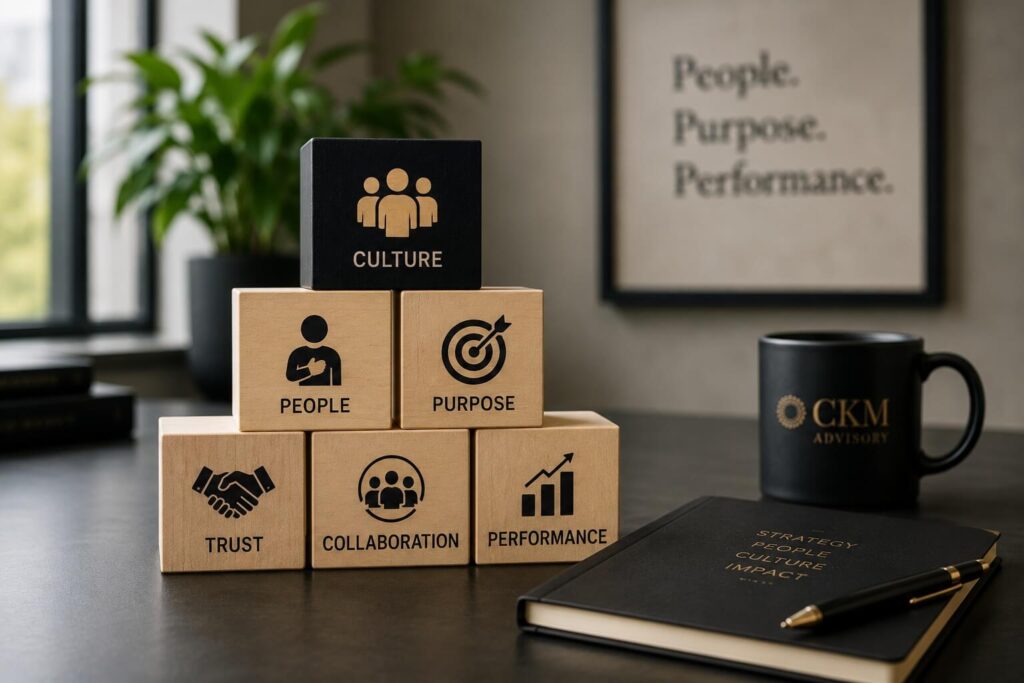
For many years, conversations about culture occupied the margins of business strategy.
Culture was often viewed as intangible; important perhaps, but secondary to financial performance, operational efficiency, and growth. It was treated as a “people issue,” separate from the commercial priorities that occupied boardrooms and executive agendas.
That view is becoming increasingly difficult to sustain.
Across industries and organisational contexts, leaders are recognising a more fundamental truth: culture is not separate from business performance. It shapes it.
Culture influences how decisions are made, how people collaborate, how organisations respond to change, and ultimately whether strategy succeeds or stalls. While strategy may define direction, culture determines how effectively an organisation moves toward it.
This is why people and culture can no longer be viewed as soft or peripheral considerations.
They are strategic business priorities.
Culture Shapes Organisational Performance
At its core, culture reflects the shared values, behaviours, assumptions, and norms that shape everyday organisational life.
It is often described as “how things are done around here,” but its impact extends far beyond workplace atmosphere or employee sentiment.
Culture influences:
- Accountability
- Innovation
- Trust
- Leadership effectiveness
- Organisational resilience
- Customer experience
- Long-term sustainability
Whether consciously shaped or left to evolve unintentionally, culture is always present and always influential.
Culture Becomes Most Visible When It Is Weak
The challenge is that culture is often most visible when it is not working.
Leaders encounter its effects through disengagement, resistance to change, poor collaboration, declining morale, ethical failures, or persistent execution challenges. In these moments, organisations sometimes attempt to solve performance problems through structural or procedural changes alone, overlooking the cultural dynamics that may be undermining progress.
Processes matter.
Systems matter.
But culture determines whether people bring those systems to life in meaningful and sustainable ways.
Why Culture Matters During Change
This becomes particularly important during periods of transformation.
Organisational change places pressure on culture. Mergers, restructuring, digital transformation, new operating models, and shifts in market conditions all require people to adapt. Where trust is low or cultural alignment is weak, change efforts frequently encounter friction and fatigue.
By contrast, organisations with strong cultures are often better equipped to navigate uncertainty.
This is not because strong cultures avoid difficulty. Rather, they provide the relational and behavioural foundation necessary to respond with cohesion, adaptability, and shared commitment.
Leadership and Culture Are Inseparable
Leadership plays a defining role in this process.
Culture is shaped not only by organisational values displayed on walls or websites, but by leadership behaviour experienced every day. Employees pay close attention to what leaders reward, tolerate, prioritise, and model.
Culture follows behaviour.
This places an important responsibility on leaders.
Authentic culture-building requires consistency between organisational aspiration and leadership practice. Trust grows when leaders communicate transparently, demonstrate fairness, and engage meaningfully with people. Conversely, misalignment between stated values and lived experience can erode confidence and weaken organisational credibility.
Culture therefore cannot be delegated entirely to human resources functions or internal programmes.
It is a leadership responsibility.
Culture Is Not Static
Equally important is recognising that culture is not static.
Organisations evolve, workforces change, and external realities shift. Healthy cultures are not rigid or fixed; they remain anchored in clear values while adapting to emerging needs and contexts.
Leaders who approach culture with curiosity and intentionality are better positioned to sustain relevance and engagement over time.
People and Performance Are Not Competing Priorities
Importantly, investing in people and culture is not at odds with commercial performance.
The opposite is often true.
Research and organisational experience increasingly demonstrate that environments characterised by trust, inclusion, psychological safety, and meaningful leadership tend to experience stronger engagement, better collaboration, and improved organisational outcomes.
People perform best where they feel valued, supported, and connected to purpose.
This does not imply the absence of accountability or performance expectations. High-performing cultures combine humanity with clarity. They hold people to meaningful standards while recognising that sustainable performance depends on both capability and wellbeing.
Culture as a Strategic Asset
The future of leadership will increasingly belong to organisations that understand this balance.
As the world of work continues to evolve, competitive advantage will depend not only on strategy or technology, but on the quality of organisational culture and the leadership that sustains it.
Culture is not a soft issue.
It is a strategic asset.
And for organisations seeking lasting impact and sustainable success, it deserves to be treated as such.